


































The annual student survey we took in January was Peddie’s way of checking in on the well-being of the entire student body, including questions about how comfortable we feel asking for help, how we feel judged by our peers, and how we feel about social and academic pressure. I breezed through most of the questions — click, next item; click, next item. But a few made me pause. They were about whether we feel able to live up to the standards and expectations of our teachers and other adults at school.
Staring at the Likert scale — a survey tool that turns experiences and feelings into data through a range of answer choices from “strongly disagree” to “strongly agree — part of me wanted to choose the version of myself I want others to see. But another part knew the more honest answer: Maybe I’m not entirely fine. Maybe I’m struggling.
Peddie is full of high achievers, and celebrating achievement is part of our culture. But the survey prompted honesty by asking what all that achievement feels like from the inside. The more I thought about those questions, the more I realized how difficult it can be to admit when we may feel overwhelmed.
The pressure many of us experience at Peddie is not just the amount of schoolwork. It is also the feeling of being behind, and that even catching up may not feel like enough. The math test is coming up, but I cannot study for that now. I need to finish history homework tonight. And I still have to revise my English paper this weekend — I’ve been putting it off. But what about the research I’ve been doing for the Psych Club? When am I going to sleep?
There is also the pressure not just to do well, but to keep doing well. The perpetual stream of homework, quizzes and assessments keeps us on edge. A solid performance can feel like a relief, but it can also feel like pressure to keep that momentum going, like a hamster on a wheel. And one setback can sometimes feel hugely disappointing. Multiply that by the number of classes, and it is easy to see how that pressure can start to snowball.
But the problem is not Peddie’s high standards themselves. It is what can happen when we start tying our self-worth to them — when we refuse to see one bad grade as just a setback and start treating it like evidence that we are falling short or not enough. When that happens, the pressure is no longer just academic; it can start to affect how we see ourselves.
So the survey we took matters. It was about trying to understand how we are actually feeling. Yes, a survey cannot capture everything, and it is not meant to be a diagnosis. But the results can help reveal what may go unseen, and they can be a starting point for having more honest conversations on campus. Even if the results only confirm what may already seem obvious, one thing should still be true at Peddie: meeting high academic standards and expectations should not come at the expense of our overall well-being.
And if the survey can lead to more honest conversations, it should also remind us that support already exists at Peddie. We have faculty advisors, deans, teachers, coaches, and, of course, friends, we can always turn to.
CAPS (Counseling and Psychological Services) is also an important resource provided by Peddie. Even if you have never reached out, you have probably heard of it. A lot of us may think counseling is for “serious problems.” However, speaking with Dr. Kalkus, director of counseling, made me realize CAPS is more of a space where we can simply talk about the issues or concerns we may have, whether academic stress or personal life, within ourselves or in our relationships with our parents or friends. He said one of CAPS’s goals is to help us understand why we care about these things, how they affect us, and how we can better understand ourselves, especially when life simply feels heavy. There is also the awkwardness of not knowing how to begin. I had that worry too. However, starting can be as simple as saying, “I’ve been feeling overwhelmed.” Dr. Kalkus said the talk is kept confidential, and “it can be just about you; we don’t need to loop in anyone else immediately.”
According to Dr. Kalkus, pressure often builds slowly, especially when we start comparing ourselves or when we feel we need to prove something to others. Over time, that pressure doesn’t remain contained to academics, but eventually spills into everything else we do. Comparing it to a shaken can of Coke, he said that if the pressure keeps building inside, it will inevitably burst.
When asked what message Dr. Kalkus would like to share with the student body, he said, “The idea that you can do everything 100% percent is a fantasy. It is okay not to be the person who tries to do everything. The reality in life involves making sacrifices, and recognizing your own limitations, and working on them. When it comes to relationships, too, it can’t always be about you.”
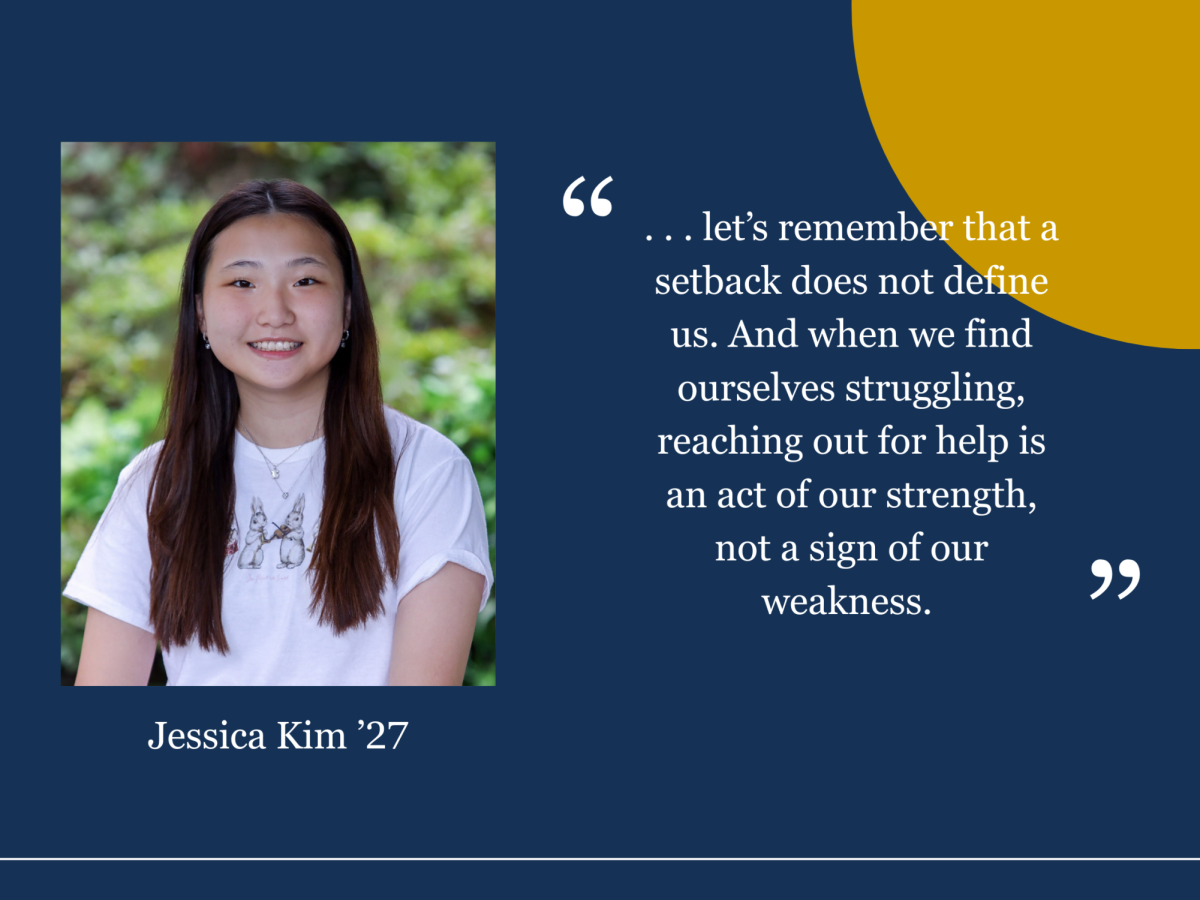
As spring has arrived on Peddie’s campus, let’s remember that a setback does not define us. And when we find ourselves struggling, reaching out for help is an act of our strength, not a sign of our weakness. Being challenged is a core part of Peddie. But support should be a core part of it too — and that support can always be found and strengthened at Peddie.