


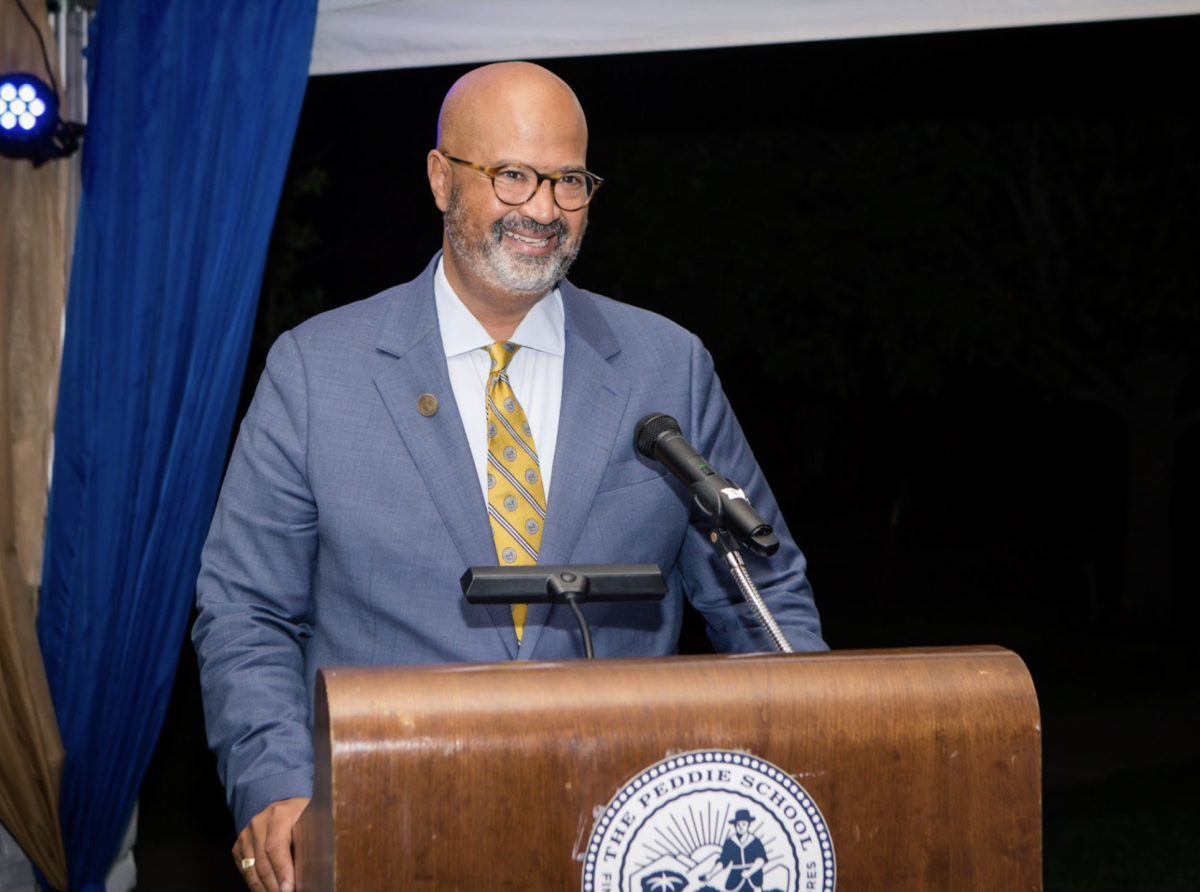


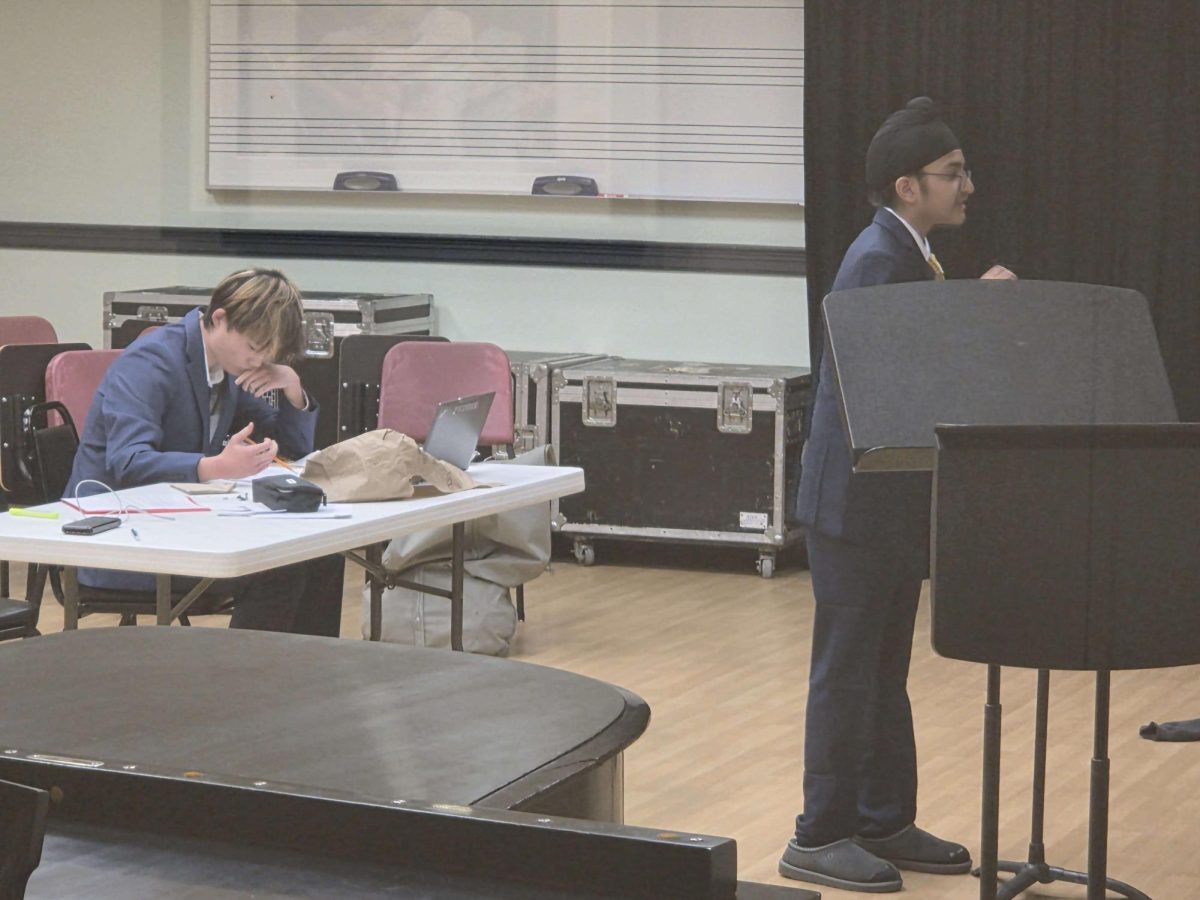
























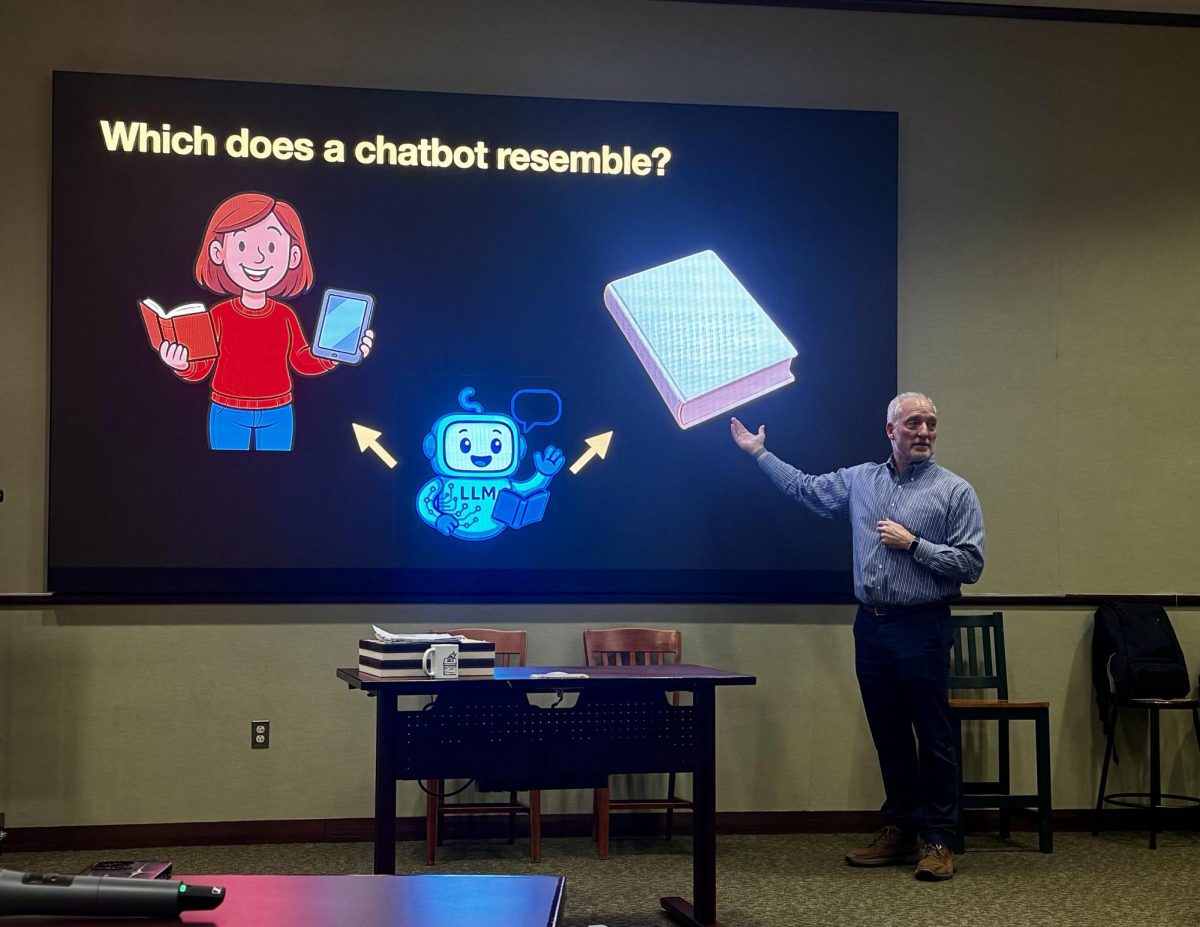
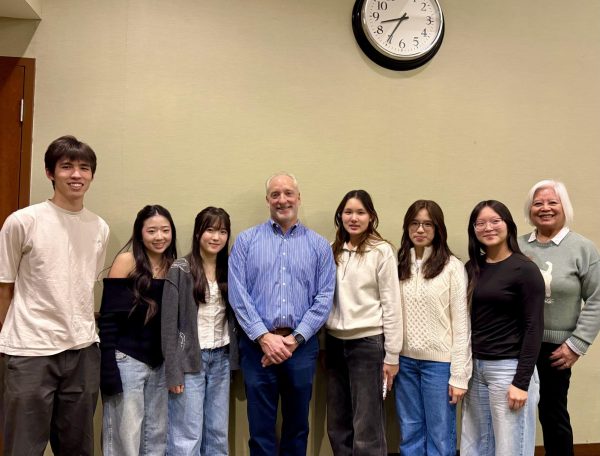
On Thursday, January 8, the Computer Science (CS) EXP hosted a seminar featuring Peddie trustee and Harvard Engineering and Applied Sciences professor Dr. Mike Smith ’79, who discussed artificial intelligence (AI) and his approach to its usage in an educational setting.
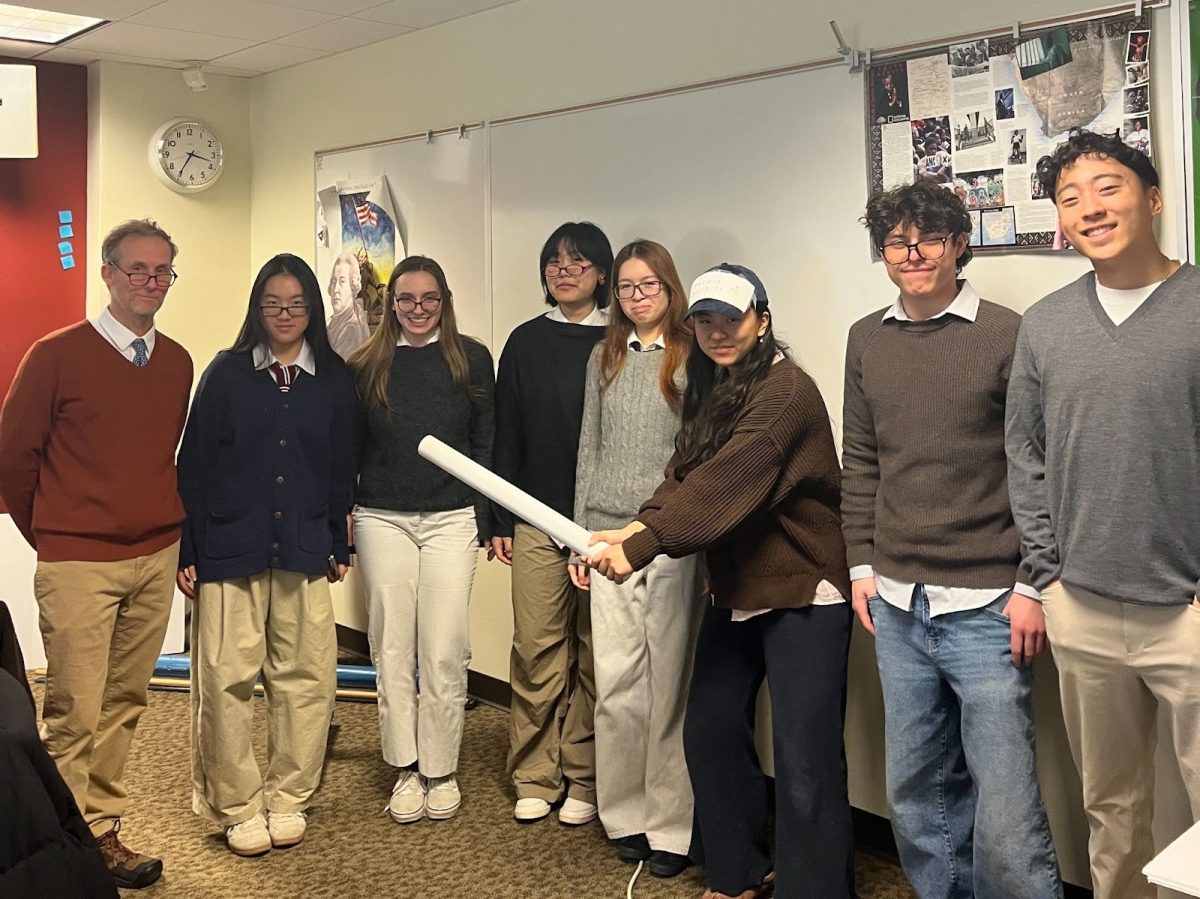
The seminar is the second of three seminars that the CS EXP prepares each year. CS EXP students lead organizational efforts to gain experience. Each seminar is recorded and later made available to all Peddie CS students.
This speaking event was coordinated with the help of Ms. Luca, Instructional Technology and Innovation Specialist in Peddie’s Tech Department. “Dr. Smith emailed us,” Ms. Luca said, explaining that Associate Head of School Ms. Rodrigue had connected her with Dr. Smith after he reached out with a proposal to speak at Peddie. As a trustee, Dr. Smith spends a considerable amount of time on Peddie’s campus. He also visits computer science classrooms often, according to Director of the CS Signature Experience Ms. Wolfe. As such, giving a seminar to the community was a natural move.
To open the talk, Dr. Smith briefly discussed his interests related to AI and his desire to learn how to achieve better learning outcomes with it and adapt to its evolving technology. He then launched straight into a candid reflection of a failure he experienced trying to implement AI into his classroom. “In my introduction to computer science class, I tried to build a chatbot into a tutor,” he explained. “Could we scale the help that we got by producing a tutor bot that could answer some of the students’ questions?”
The answer? Yes and no. Dr. Smith successfully built a chatbot named ‘Cosmo’ after his pet dog. The issue was how much to constrain it, or how strictly to apply boundaries and guidelines to its behavior. A system prompt was added to restrict Cosmo’s abilities, such as not giving assignment answers, and otherwise forcing the chatbot to act like a tutor. However, Cosmo was still under-constrained, causing the AI to sometimes provide too much information when students were just looking for a bit of help.
Dr. Smith and his team experimented with longer prompts and even a second AI to review the first AI’s answers, but this resulted in an over-constrained, rarely helpful model. To construct a perfectly effective chatbot with specific abilities is surprisingly difficult.
Dr. Smith also reflected on his policy regarding AI use in the classroom, sharing that he has adopted what he likes to call his ‘halfway rule’: “I have to, at some point, actually allow students to engage with the AI for the work that I’m doing in my classrooms […] at some point in my class, I have to stop telling them ‘you can’t use AI in ways that I don’t want you to use it for assessments and assignments’,” he said.
Dr. Smith sees it as the teacher’s responsibility to create engaging assignments that help students learn and want to learn, regardless of whether AI and student use of it is constrained or not. For example, when his class did a unit on deepfakes — AI clones utilizing people’s visual and vocal likeness — Dr. Smith had students create an educational video using a deepfake of a classmate. This sparked a larger conversation about the dangers of deepfake and AI technology and the importance of consent and privacy. But most importantly, the students were excited to experiment and learn new skills through this kind of experiential learning.
After concluding his roughly 30-minute lecture, Dr. Smith opened up the floor for questions for another half hour. During this Q&A portion, students and faculty asked for Dr. Smith’s opinions on topics such as AI companions, children and AI usage and AI’s effects on the environment. A few also asked about his views on the supposed ‘AI Crisis’ and his predictions for future developments in AI.
Although the seminar was titled “The AI Crisis in the Classroom,” Dr. Smith’s outlook regarding the relationship between humanity and AI was optimistic. “We don’t need to use the word crisis,” he said. “I think you need to think about your assignments differently. . . [it’s like] ‘what does this enable?’ and let’s think about the transition period in getting to it.”